


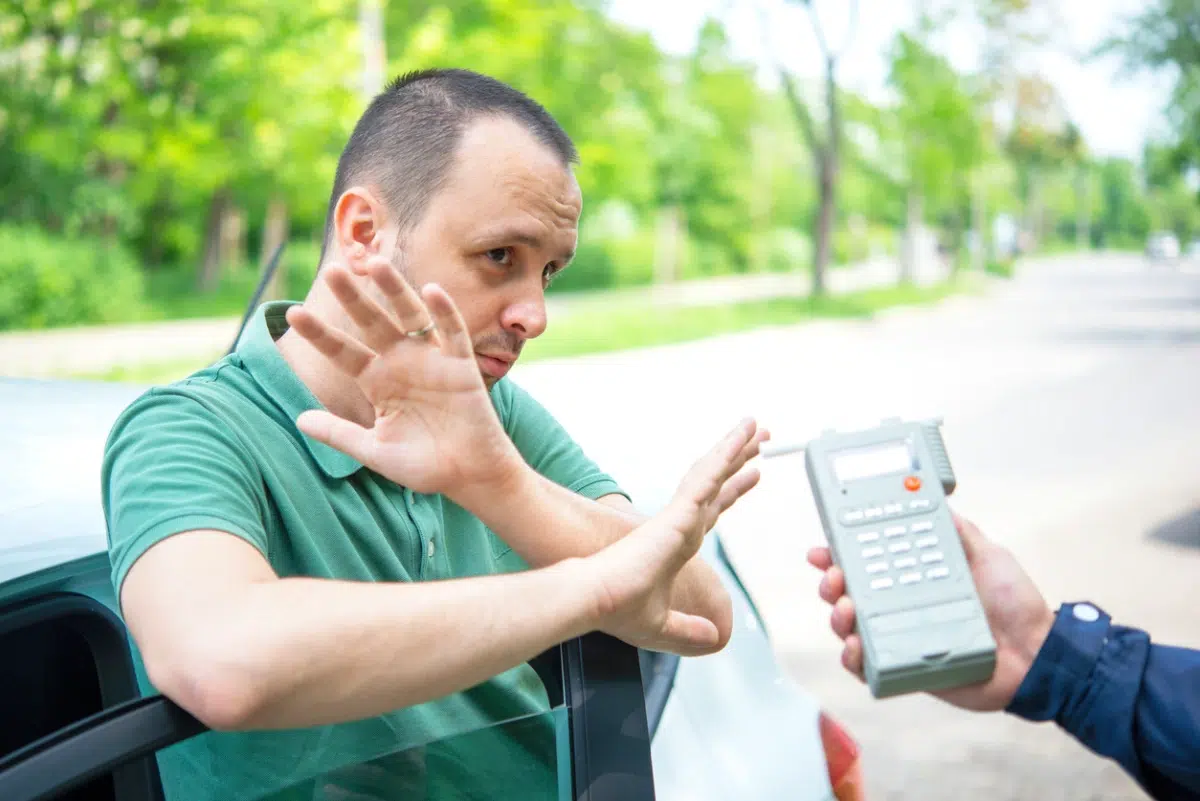


You are driving home when flashing lights appear behind you, and a routine traffic stop quickly turns serious. After a few questions and field sobriety tests, an officer asks you to take a breath test. You may have heard different advice about whether to refuse or comply, but in that moment, the decision must be made quickly. What you choose can affect your driver’s license, your DUI case, and your future.
At Gressley & Donaldson, we defend individuals facing DUI charges across California. In this article, we explain whether you can refuse a breathalyzer test, how California law treats refusals, and the risks you should understand before making that choice.
Overview of California’s DUI Framework
Before we talk about refusing a breath test, it helps to understand how California handles DUI cases as a whole. DUI enforcement here is built around public safety, chemical testing, and fast administrative action. Once a DUI stop turns into a DUI arrest, things move quickly, often on more than one track at the same time.
California DUI cases almost always involve two systems working side by side. One is the criminal court. The other is the Department of Motor Vehicles. Each has its own rules, deadlines, and penalties, including actions against your driver’s license under both systems.
California law defines driving under the influence in a few ways. The most common is driving with a blood alcohol concentration of 0.08 percent or higher. A driver can also face a DUI charge if an officer claims alcohol or drugs affected their ability to drive safely, even without a high number on a test.
Chemical testing plays a central role in both criminal court and the DMV. A chemical test, such as a breath or blood test, gives the state a blood alcohol number it can point to. When a driver refuses a required test, California law treats that refusal as its own issue, separate from whether the driver was actually impaired. Such a refusal can lead to additional penalties in both criminal court and with the DMV.
This is why understanding California’s DUI laws, especially around testing, matters so much. A single decision during a stop can affect your driver’s license, your DUI case, and your future driving privileges.
Implied Consent and Its Implications
California’s implied consent laws sit at the center of DUI test refusal cases. The implied consent law is often misunderstood, which is why refusal can lead to serious consequences.
When you drive on California roads, the implied consent law requires you to submit to a chemical test (a breath or blood test) if you are lawfully arrested for a DUI offense. This agreement is not something you sign during a traffic stop. It is part of the privilege of driving a motor vehicle in the state.
Implied consent applies only after a lawful DUI arrest. Before an arrest, law enforcement officers may ask you to perform field sobriety tests or take a preliminary alcohol screening test using a roadside breath test device. A preliminary alcohol screening test is an investigative tool, and is separate from the the post-arrest DUI chemical test required under California law.
After an arrest, the officer will request a chemical test of your breath or blood. In most alcohol-only cases, this means a driver has the choice of submitting to a breath or blood test. In certain situations, such as suspected drug intoxication or when breath testing is not practical, a blood or urine test may be requested instead. Drivers arrested for driving under the influence of a drug are still statutorily entitled to submit to a breathalyzer test under California’s implied consent laws.
Refusing or failing to complete the required chemical test after arrest is what triggers potential penalties through the DMV. Whether the DUI charge is later reduced or dismissed does not stop this process. The DMV focuses on whether the driver was lawfully arrested , whether a person was advised of their obligation to submit to a chemical test, accurately advised of the consequences of failing to complete a chemical test, and whether the driver actually refused a chemical test.
One of the most common sources of confusion is the difference between the roadside test and the post-arrest test. The preliminary alcohol screening test is part of the investigation. The post-arrest breathalyzer test is the one tied directly to implied consent and potential license suspension. Mixing the two up can lead to serious consequences during a DUI stop.
Consequences and Legal Ramifications of Refusing a Breath Test
Refusing a breath test may feel like you’re protecting yourself at the moment. In California, refusing a breathalyzer test can affect both your driver’s license and your criminal case. If a driver refuses a post-arrest implied consent breath test, then the law requires the driver to submit to the remaining option – a post-arrest blood test. For that reason, a driver can lawfully refuse a breathalyzer so long as they submit to a post-arrest blood test.
From the DMV’s perspective, a refusal after a lawful DUI can trigger a license suspension under the Administrative Per Se process. For a first refusal, the DMV can impose a driver’s license suspension for one full year. If there are prior DUI convictions or a prior refusal within the past ten years, the suspension period increases. A second refusal can result in a two-year revocation of driving privileges, and a third in a three-year revocation.
After an arrest, officers usually take your physical license and issue a temporary paper license that is valid for a short period, and notifies the driver of a potential license suspension. You have only ten days to request a DMV hearing. If that deadline is missed, the suspension may begin without a hearing, even before the court case moves forward. If a deadline is missed, a late-hearing request can be made to the Department of Motor Vehicles.
In criminal court, refusing a breath test cannot be used against you, as long as you submitted to a post-arrest blood test. If a driver refused both a breath and blood test, a criminal enhancement for refusing a chemical test for refusal may be alleged. Prosecutors often argue that refusal shows consciousness of guilt. They may push for harsher criminal penalties, longer educational programs, or stricter probation terms in response to that refusal.
Refusal may also be presented as evidence. Even without a breath or blood number, the state can rely on officer observations, body camera footage, and the refusal itself to build a case for a judge or jury.
Not every refusal leads to the same outcome. Certain factors can change the severity of the consequences. Prior DUI convictions matter. Being on DUI probation matters. Medical conditions that make blowing difficult can matter, especially when properly documented. How clearly the officer explained the test and the consequences of refusal often becomes one of the most critical issues in the case.
Types of Breath and Chemical Tests Used in California
Different tests come into play at different points during a DUI investigation. Each one serves a specific purpose, and timing matters. Knowing which DUI chemical test is being used helps explain how law enforcement officers build a case and where errors or misunderstandings can occur.
Preliminary Alcohol Screening (PAS) Test
The Preliminary Alcohol Screening PAS test is the handheld breath device officers often use at the roadside. This PAS breath test is part of the investigation phase, not the formal evidence stage.
Officers use the PAS to help decide whether there is probable cause to make an arrest. It provides a quick estimate of alcohol presence, but it is not the official breathalyzer test in California administered after an arrest. Roadside conditions, mouth alcohol, and device handling can all affect the result.
Many drivers ask whether they should take this test. That choice can influence how a DUI stop continues, even before an arrest is made. Officers should advise drivers that they have a right to refuse a PAS breathalyzer test in California under Vehicle Code section 23612, subdivision (i).
Evidential Breath Test After Arrest
Once a driver is arrested for a DUI offense, officers usually request an evidential breath or blood test. This is post-arrest breathalyzer test tied to California’s implied consent laws.
These machines are designed to measure breath alcohol levels for legal purposes, often reported as blood alcohol concentration. They are subject to rules involving calibration, observation time, and proper procedures. This is the test refusal penalty under California law, and it carries more weight than the PAS test used earlier.
Confusion between this post-arrest breath test and the preliminary alcohol screening is common and frequently becomes a central issue in a DUI case.
Blood Testing
Drivers arrested for DUI have the option to submit to a breathalyzer test or blood test after a lawful DUI arrest. If a driver submits to a breathalyzer test, the driver has the additional right to submit to a breath or urine test for retesting. This is often called a Trombetta sample, and is authorized under Vehicle Code section 23614, and allows a driver to retest that blood or urine sample at a later time. This is due to the fact that the breath sample provided by drivers cannot be retested at a later date for accuracy.
Blood testing is frequently used in California DUI investigations, especially when officers suspect drug intoxication, when a crash is involved, or when breath testing is not practical.
Although blood tests are often viewed as more precise, accuracy depends on how the sample is collected, labeled, stored, and tested. Delays, contamination, or paperwork issues can affect reliability. Blood results also take time, even though court and driver’s license consequences may begin right away.
Drug Screening and Urine Testing
When drugs are suspected, chemical testing usually shifts toward blood analysis rather than breath. Drug screening looks for substances that may affect driving, but it does not always show when the impairment occurred.
Urine testing is less common and is usually considered an alternative chemical test when blood testing is unavailable or cannot be completed. A urine sample tends to provide broader results and can raise timing questions that sometimes matter in court.
How Field Sobriety Tests Fit Into the Case
Field sobriety tests are not chemical tests, but they often play a supporting role in DUI investigations. Officers use them to describe balance, coordination, and divided attention before requesting further testing.
These tests are highly subjective. Stress, fatigue, medical conditions, injuries, footwear, uneven pavement, and nerves can all affect performance. In many cases, video footage provides a clearer picture than the written report, especially when the officer’s description does not line up with what actually happened. Drivers do not have to agree to perform field sobriety tests.
Steps During a DUI Stop and Arrest
A DUI stop in California often feels chaotic, but from the officer’s side, it usually follows a familiar sequence. Knowing how each step unfolds helps explain why certain decisions, especially around testing, carry so much weight. This is also where small details during a DUI investigation can make or break a case later.
The Initial Traffic Stop and Officer Observations
Most DUI cases begin with a routine traffic stop. Law enforcement officers may pull you over for something minor, like drifting within a lane, speeding, or a broken taillight. Even at this early stage of the DUI stop, the officer is already observing closely.
They watch how you respond when you pull over, how you speak, and how you move. Simple details like fumbling for documents, bloodshot eyes, or the smell of alcohol often end up in the report. None of these alone proves drunk driving, but officers tend to stack observations together to justify continuing the DUI investigation.
Everything said and done during these first few minutes of the traffic stop often becomes the foundation of the DUI case.
How Probable Cause Is Built and the Role of Preliminary Testing
After the initial contact, officers usually ask questions about where you’re coming from and whether you’ve had anything to drink. These questions are designed to gather statements that support probable cause.
Field sobriety tests may follow. In California, these tests are voluntary, but many drivers do not realize that at the time. Officers use them to look for signs of impairment, even though nerves, injuries, poor lighting, or uneven pavement can affect performance.
In many cases, the officer then offers a roadside breath test, often called a Preliminary Alcohol Screening PAS or preliminary breath test. This handheld device is used before an arrest to support the officer’s decision-making. It is not the same as the post-arrest DUI chemical test, and it does not satisfy California’s implied consent requirement.
If the officer believes there is now enough probable cause, a DUI arrest follows. If a driver refuses a PAS or preliminary breathalyzer test, the driver will often be arrested based solely on the officer’s observations during field sobriety tests.
What Happens After Arrest and How Refusal Is Addressed
Once you are under arrest for DUI, the situation changes immediately. This is when California’s implied consent law applies. The officer must advise you that you are required to take a chemical test, meaning a breath or blood test, and that refusing carries specific legal penalties.
The warning should explain that refusal can lead to a driver’s license suspension or revocation, separate from anything that happens in criminal court. The officer will then ask whether you will submit to the test.
Refusal does not always look like a clear “no.” A driver may be marked as refusing if they delay too long, argue instead of answering, fail to follow instructions, or cannot provide a sample that the device accepts. Whether that truly qualifies as refusing a breathalyzer often depends on how the interaction unfolded and whether the officer clearly explained the requirements.
This moment is one of the most contested parts of many DUI cases.
Why Knowing Your Rights and Options Matters at This Stage
What happens during a DUI stop and DUI arrest sets the tone for everything that follows. The DMV case, the criminal case, and even your short-term ability to drive are all shaped here.
You are not required to explain your life story or guess your way through legal decisions on the roadside. Staying calm, limiting what you say, and listening carefully to instructions can help avoid unnecessary problems. Asking to speak with a DUI attorney as soon as possible is often one of the few proactive steps available after an arrest.
In California, deadlines begin running almost immediately. Knowing your rights and acting early can help protect your options, which can disappear quickly if ignored.
Protecting Your Rights and Seeking Legal Guidance
Chemical test refusal cases require close attention to detail. Small errors in how a DUI stop, DUI arrest, or test request was handled can change the outcome entirely.
A skilled Riverside DUI attorney can review whether the stop was lawful, whether the arrest met California standards, and whether implied consent warnings were properly given. In refusal cases, it’s especially important to look at communication. Were instructions clear? Was the warning complete? Was the refusal truly willful, or was there confusion, panic, or a medical condition that made testing difficult?
Legal defenses often focus on challenging the basis for the arrest, the way the refusal was recorded, and whether law enforcement officers followed proper procedures. These issues can affect both the criminal case and the DMV hearing.
Timing is critical. DMV hearings must be requested quickly, and evidence should be preserved early. Waiting too long can limit options, even in strong cases.
Refusing a breath test in California is not a simple choice, and it is not a guaranteed shield. If you have already refused, that does not mean your case is lost. It means the defense needs to be careful, fact-driven, and built around what actually happened.
Talk With Us About Your Breath Test Refusal
Refusing a breath or chemical test after a DUI arrest in California can trigger serious consequences, including a driver’s license suspension, and the timeline to act is short. Early guidance can make a real difference in how the legal process unfolds and in protecting your ability to drive.
If you have questions about refusing a breathalyzer test and what that decision means for your case, the team at Gressley & Donaldson is here to help. Call (951) 319-3199 or visit our Contact Us page to schedule a consultation. A timely conversation can help you understand your rights, evaluate your options, and take control of what happens next.